---
title: Conntinuum — Your AI Product Development Platform
description: Conntinuum is an AI-enhanced, human-led, spec-driven platform for end-to-end product development that holds context from first conversation to final commit.
image: https://www.cinfinitysolutions.com/hubfs/raw_assets/public/c-infinity/images/social-default.png
---
[Skip to content](https://www.cinfinitysolutions.com/conntinuum#ci-main)
[ ](https://www.cinfinitysolutions.com?hsLang=en)
What we do
[Clients & Industries](https://www.cinfinitysolutions.com/clients-and-industries?hsLang=en)
Conntinuum
[Government](https://www.cinfinitysolutions.com/government?hsLang=en)
Insights
Our Company
[Get in touch](https://www.cinfinitysolutions.com/contact?hsLang=en)
#### The Outcomes We Deliver
[An Overview of the Work We Deliver](https://www.cinfinitysolutions.com/what-we-do?hsLang=en) [Build](https://www.cinfinitysolutions.com/build?hsLang=en) [Modernize](https://www.cinfinitysolutions.com/modernize?hsLang=en) [Automate](https://www.cinfinitysolutions.com/automate?hsLang=en) [Implement](https://www.cinfinitysolutions.com/implement?hsLang=en) [Operate](https://www.cinfinitysolutions.com/operate?hsLang=en) [Strategize](https://www.cinfinitysolutions.com/strategize?hsLang=en)
#### How We Deliver
[Our Engagement Models](https://www.cinfinitysolutions.com/engagement-models?hsLang=en) [Partnerships & Certifications](https://www.cinfinitysolutions.com/partnerships-and-certifications?hsLang=en) [The C3V Methodology](https://www.cinfinitysolutions.com/c3v-methodology?hsLang=en)
#### Specialized Offerings
[AI Enablement Workshops](https://www.cinfinitysolutions.com/ai-workshops?hsLang=en) [Forge Solutions Designed for Small and Growing Businesses](https://www.cinfinitysolutions.com/forge?hsLang=en)
#### The Conntinuum Spec-Driven Development Platform
[Conntinuum](https://www.cinfinitysolutions.com/conntinuum) [The Vibe-Coding Problem](https://www.cinfinitysolutions.com/conntinuum/the-problem?hsLang=en) [Spark Lab](https://www.cinfinitysolutions.com/conntinuum/spark-lab?hsLang=en) [The C3V Methodology](https://www.cinfinitysolutions.com/c3v-methodology?hsLang=en)
#### Our Thinking, Writing, & Insights
[Insights](https://www.cinfinitysolutions.com/insights?hsLang=en) [Limitless: The C Infinity Blog](https://www.cinfinitysolutions.com/insights/limitless?hsLang=en)
#### About C Infinity
[Our Company](https://www.cinfinitysolutions.com/our-company?hsLang=en) [Our People](https://www.cinfinitysolutions.com/our-people?hsLang=en) [Guiding Principles](https://www.cinfinitysolutions.com/guiding-principles?hsLang=en) [What Does C Infinity Mean?](https://www.cinfinitysolutions.com/what-is-c-infinity?hsLang=en) [Careers](https://www.cinfinitysolutions.com/careers?hsLang=en) [The C Infinity Glossary](https://www.cinfinitysolutions.com/glossary?hsLang=en)
What we do
[An Overview of the Work We Deliver](https://www.cinfinitysolutions.com/what-we-do?hsLang=en) [Build](https://www.cinfinitysolutions.com/build?hsLang=en) [Modernize](https://www.cinfinitysolutions.com/modernize?hsLang=en) [Automate](https://www.cinfinitysolutions.com/automate?hsLang=en) [Implement](https://www.cinfinitysolutions.com/implement?hsLang=en) [Operate](https://www.cinfinitysolutions.com/operate?hsLang=en) [Strategize](https://www.cinfinitysolutions.com/strategize?hsLang=en)
How We Deliver
[Our Engagement Models](https://www.cinfinitysolutions.com/engagement-models?hsLang=en) [Partnerships & Certifications](https://www.cinfinitysolutions.com/partnerships-and-certifications?hsLang=en) [The C3V Methodology](https://www.cinfinitysolutions.com/c3v-methodology?hsLang=en)
Specialized Offerings
[AI Enablement Workshops](https://www.cinfinitysolutions.com/ai-workshops?hsLang=en) [Forge](https://www.cinfinitysolutions.com/forge?hsLang=en)
[Clients & Industries](https://www.cinfinitysolutions.com/clients-and-industries?hsLang=en)
Conntinuum
[Conntinuum](https://www.cinfinitysolutions.com/conntinuum) [The Vibe-Coding Problem](https://www.cinfinitysolutions.com/conntinuum/the-problem?hsLang=en) [Spark Lab](https://www.cinfinitysolutions.com/conntinuum/spark-lab?hsLang=en) [The C3V Methodology](https://www.cinfinitysolutions.com/c3v-methodology?hsLang=en)
[Government](https://www.cinfinitysolutions.com/government?hsLang=en)
Insights
[Insights](https://www.cinfinitysolutions.com/insights?hsLang=en) [Limitless: The C Infinity Blog](https://www.cinfinitysolutions.com/insights/limitless?hsLang=en)
Our Company
[Our Company](https://www.cinfinitysolutions.com/our-company?hsLang=en) [Our People](https://www.cinfinitysolutions.com/our-people?hsLang=en) [Guiding Principles](https://www.cinfinitysolutions.com/guiding-principles?hsLang=en) [What Does C Infinity Mean?](https://www.cinfinitysolutions.com/what-is-c-infinity?hsLang=en) [Careers](https://www.cinfinitysolutions.com/careers?hsLang=en) [The C Infinity Glossary](https://www.cinfinitysolutions.com/glossary?hsLang=en)
[Get in touch](https://www.cinfinitysolutions.com/contact?hsLang=en)

# AI-enhanced, human-led, spec-driven, end to end digital product development platform.
One continuous thread, from first conversation to final commit. Most platforms start at the backlog. Conntinuum starts at the conversation, and never lets go of the context that makes great products possible.
[Ready to build with Conntinuum? →](https://www.cinfinitysolutions.com/contact?hsLang=en) [Try Spark Lab](https://www.cinfinitysolutions.com/conntinuum/spark-lab?hsLang=en)
~2 hrs From vision to fully documented backlog
70% Faster sprint development times
100% Decrease in lost context
SPEC DRIVEN DEVELOPMENT
## The Specs are the product. The code follows.
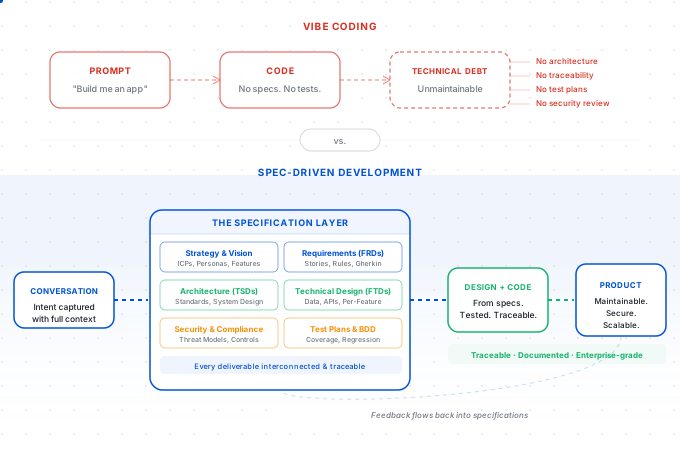
Vibe coding tools start with a prompt and go straight to code. No specifications. No architecture. No test plans. No traceability. The result is software that works on Tuesday and breaks on Friday.
Conntinuum takes a fundamentally different approach. Every product starts with a specification — a complete, interconnected document layer built by our C3V methodology and BDD process that covers strategy, requirements, architecture, security, and testing. Code is generated from those specifications, not instead of them.
That specification layer is what makes Conntinuum’s output maintainable, secure, testable, and scalable. It’s what lets your engineers understand why something was built. It’s what lets your QA team trace every test to a requirement. And it’s what vibe-coded software will never have.
How Conntinuum Works
## The Conntinuum software development process.
Open each phase to see how Conntinuum carries your product from the first conversation to the final commit, and beyond.
Step 1
### Capture & Context
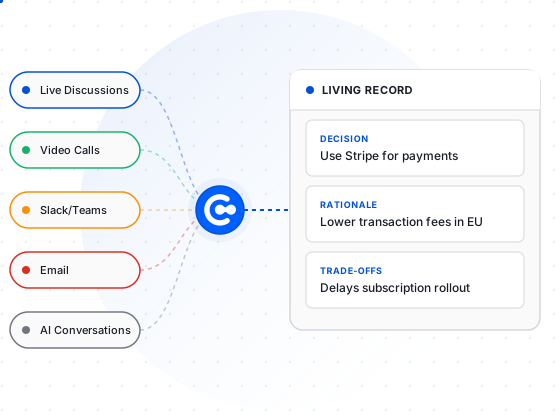
Your product vision starts in a conversation, a boardroom decision, a Slack thread, a Zoom call. Conntinuum's Splines, our specialized AI agents, show up wherever your team works and do far more than take notes. They ask the questions nobody thought to ask. They capture not just what was decided, but why.
They flag when a new decision conflicts with something agreed to six months ago. They surface relevant context from earlier in the product journey when it matters most, and they capture the rationale, the trade-offs, and the strategic intent behind every choice.
Product development is long, complicated, and easy to lose the thread of. No single person on your team can hold the full context of every decision ever made. Your Splines can. Every conversation they join adds to a living record that's visible, traceable, and available to every stakeholder and every team member, from the first discovery session to the final sprint.
Nothing gets lost in translation. Nothing has to be re-explained. The institutional knowledge of your product lives in the system, not in someone's head.
Step 2
### Specify & Refine
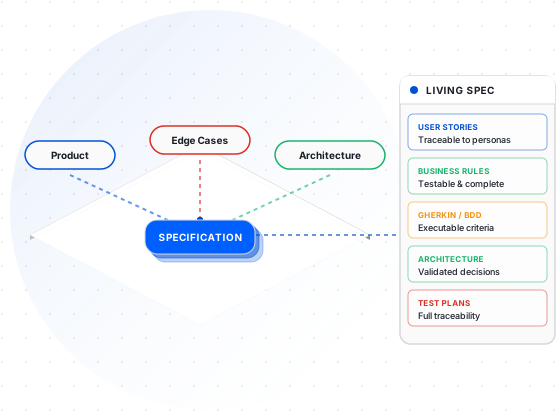
This is where Conntinuum diverges from every other tool on the market. From captured intent, your Splines produce a complete specification layer: feature requirements with testable business rules and executable Gherkin, system architecture validated against technical standards, data models, API contracts, security threat models, and comprehensive test plans. Every deliverable is interconnected. Every requirement is traceable. Every change propagates automatically.
Conntinuum's Splines don't just generate specifications once and hand them off. They maintain them. When intent evolves anywhere in the system, a decision made in a meeting, a refinement captured in a thread, a strategic pivot approved by leadership, that change propagates automatically across every connected deliverable: user personas, feature requirements, architecture decisions, acceptance criteria, test plans, and beyond.
Every artifact stays synchronized with the current truth of your product. No more chasing down which version of a spec is current. No more discovering mid-sprint that the requirements everyone was building from were updated two weeks ago and nobody told the team.
This is Spec-Driven Development. The specification isn't documentation you write after the fact. It's the artifact your product is built from.
Step 3
### Build, Ship & Evolve
When specifications are this complete, with business rules, acceptance criteria, architecture decisions, data models, and test plans all interconnected, code generation stops being a gamble. Engineers aren't interpreting a prompt. They're implementing a specification that tells them exactly what to build, how it connects to everything else, and how to verify it works. CodeXplorer Splines generate code directly from these specs, producing implementations that are maintainable, testable, and traceable from the first commit.
But deployment isn't the finish line, it's where the feedback loop begins. Customer feedback, usage patterns, support signals, and new strategic decisions feed directly back into the system. Splines surface what users are actually asking for, reconcile it against your existing product context, and help your team make informed decisions about what to build next, and why.
Your product doesn't just ship. It compounds. Every release makes the next one smarter, faster, and more aligned with the people using it. Conntinuum doesn't hand you a finished product and walk away. It stays in the room for every conversation about what comes next.
This is the promise vibe-coding tools make but can't deliver: fast software that's also good software. The difference is the specification layer underneath it.
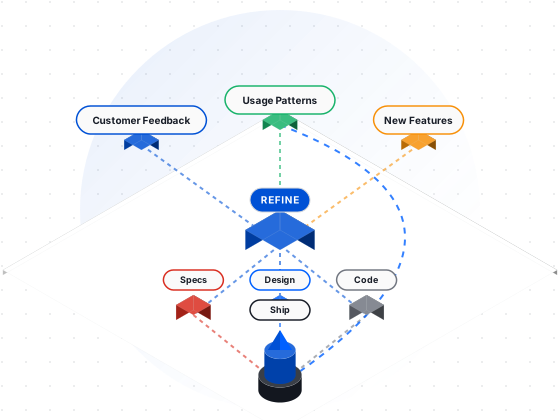
Want to see all of this happen for real? [Watch an idea become a product Below](https://www.cinfinitysolutions.com/conntinuum#watch)
See How Conntinuum Works
## Watch an idea become a product.
A real Spark Lab session, start to finish. One paragraph from a Director of Innovation becomes a Vision Board, a full set of deliverables, a prioritized backlog, engineered specs, and a shipped product. This is the whole Conntinuum journey in one scroll.
01
The spark
Director of Internal Innovation · global sportswear brand
Our product designers absorb inspiration from Fashion Week, focus groups, and industry events, but it takes on average 14 months from inspiration to a product on the shelf. We want to speed up the design iteration and feedback loop. One idea: an app where our retail associates worldwide share photos and videos from the activities they're part of outside work, run clubs, youth soccer tournaments, golf and yoga, so our designers can discover that real-world signal, discuss it with the people who captured it, and get feedback on digital prototypes.
02
The session
Spark Lab · Marcus & Rachel, AI product managers · session replay
### Vision Board 0% complete
Intent
listening…
Target users
—
Problem space
—
Success measure
—
Open decision
—
↻ Replay
03
The Vision Board
In a single, focused working session, you’ve transformed the spark of an idea into a structured, disciplined Vision Board — the strategic foundation every downstream deliverable is built from.
Vision Board · strategic foundation · v1
“Transform a global sportswear company’s worldwide retail associates into a live, distributed trend-sensing network for its product designers, compressing the design-iteration-and-validation loop from three-to-eight months down to weeks, without changing manufacturing or distribution.”
Target group~400 central designers plus up to ~10,000 retail associates; NYC pilot first
Core capabilitiesField capture, AI auto-tagging, discovery feed, threaded discussion, prototype feedback
Key differentiatorAuthentic grassroots signal; the same contributors inspire and validate
Success measureIteration and validation: 3-8 months to weeks
Open decisionAssociate adoption on personal time; protect prototype IP when sharing
04
The deliverables
From the board, Conntinuum generates the interconnected foundation. Every deliverable traces back to a decision made in the session.
5 Ideal Customer Profiles
- Central Product Designer
- Retail Associate Contributor
- Design Leadership
- Product Marketing Coordinator
- Local Activity Community Participant
7 User Personas
> “I want to ask an actual run-club regular ‘does this work?’ and hear back this week.”Maya · Footwear Product Designer
> “I already film my runs. If that could actually shape our next shoe, I’m in.”Diego · Retail Sales Associate
6 User Journeys
- Contribute real-world trend signal
- Discover authentic inspiration
- Validate a concept in weeks, not months
- Run a guided feedback session
- Access the platform securely
- Protect IP while opening feedback
05
The backlog
The personas and journeys resolve into a prioritized Feature List.
Must 12Should 9Could 2Won’t 2
FEAT-001Okta SSO & 2FA AuthenticationMust · MVP · E3 I5
FEAT-002Activity Capture Upload (Photo/Video)Must · MVP · E3 I5we follow this one →
FEAT-003Discovery FeedMust · MVP · E3 I5
FEAT-007Digital Prototype SharingMust · MVP · E3 I5
FEAT-008Prototype Feedback CaptureMust · MVP · E3 I4
FEAT-010Media Storage & Delivery PipelineMust · MVP · E4 I5
06
The spec
Take one feature, **FEAT-002 Activity Capture Upload**, all the way to a testable specification an agent can build from.
FRD-002 · Activity Capture Upload
User story
As a retail associate, I want to capture or select photos and videos and upload them, so that I can contribute real-world activity content.
Supported media uploadedGiven an associate has recorded a supported video When they submit it Then the system accepts and stores the contribution and confirms receipt
Unsupported item rejectedGiven an item exceeds the supported size or format When the associate submits it Then the system rejects it and explains why in plain language
Interrupted upload resumesGiven an upload is interrupted by lost connectivity When connectivity is restored Then the system resumes or retries and completes the upload without data loss
07
The engineering
This is where Conntinuum parts ways with vibe coding. Before any production code, the spec expands into a complete engineering package: the rigor a staff engineer would demand, generated and governed by our Splines and approved by people, not guessed at from a prompt.
System architectureServices, boundaries, and the patterns that hold them together
Data modelsEntities, relationships, and the schema code is generated against
API contractsEvery endpoint defined before it is called
Security & threat modelControls and risks named, not discovered in production
InfrastructureHow it deploys, scales, and recovers
Integration patternsHow each system talks to the next, on purpose
Decision recordsWhy each call was made, kept for whoever inherits it
Test plansThe acceptance criteria, made executable
TraceabilityEvery line of code back to the requirement it serves
Prompt-to-code tools give you code. Conntinuum gives you an engineered product: every decision documented, every requirement traceable, every test defined, before and after the code is written.
08
The build
Only now does code get written. The engineering package is the contract; the agents build against it, and it becomes the product.
Agentic IDE
› load Conntinuum spline skills56 skills loaded · spec → schema, services, API, testsgenerating from FRD-002…
Agentic design
Screens designed against the Conntinuum Design System v2, from the same spec: Discovery Feed, Capture, Asset Detail, Prototype Feedback.
And the product ships:
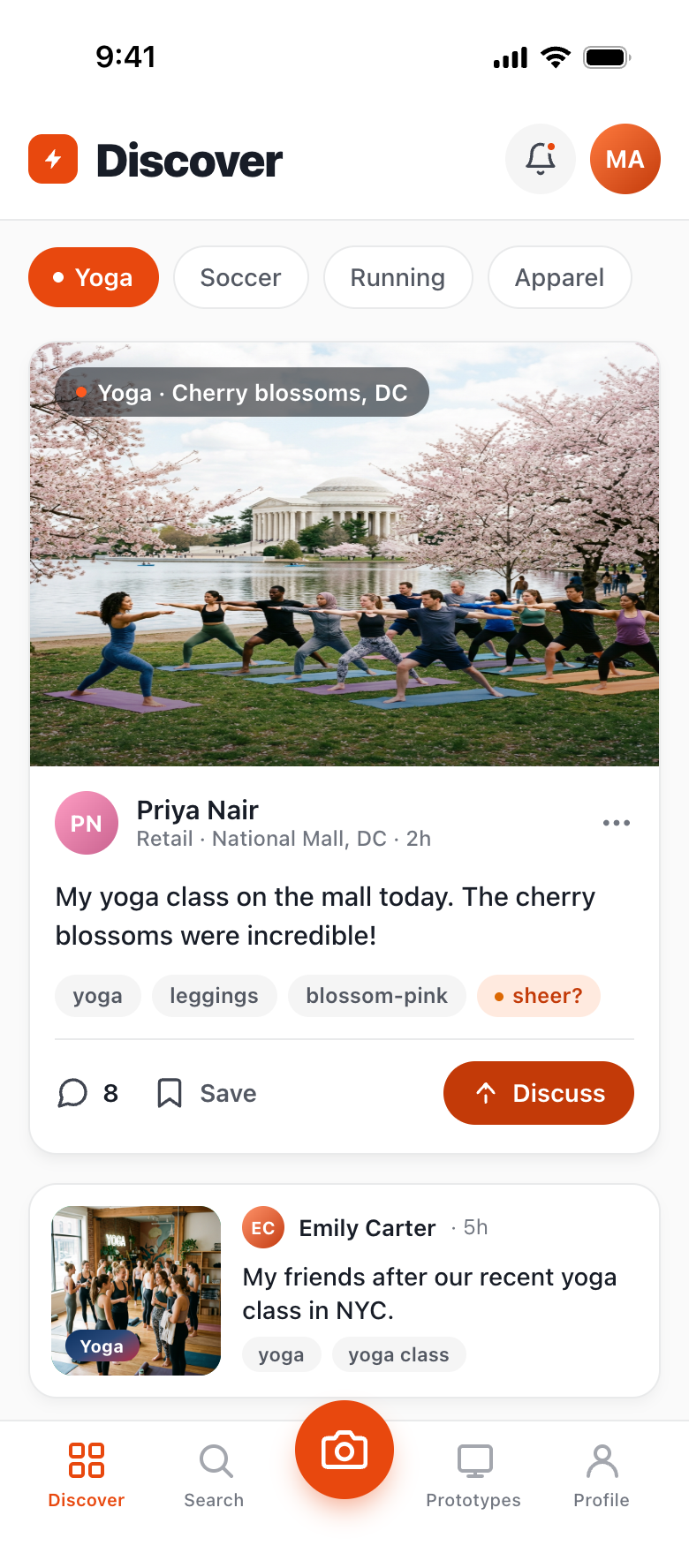
Discovery Feed

Capture
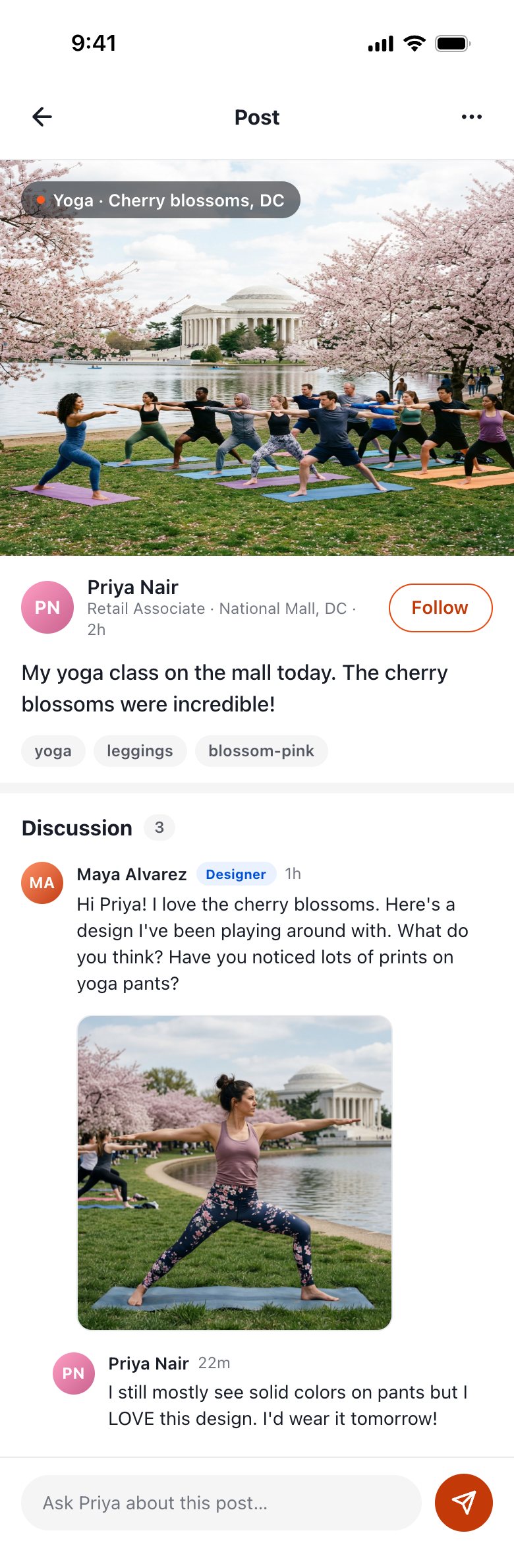
Asset + Discussion
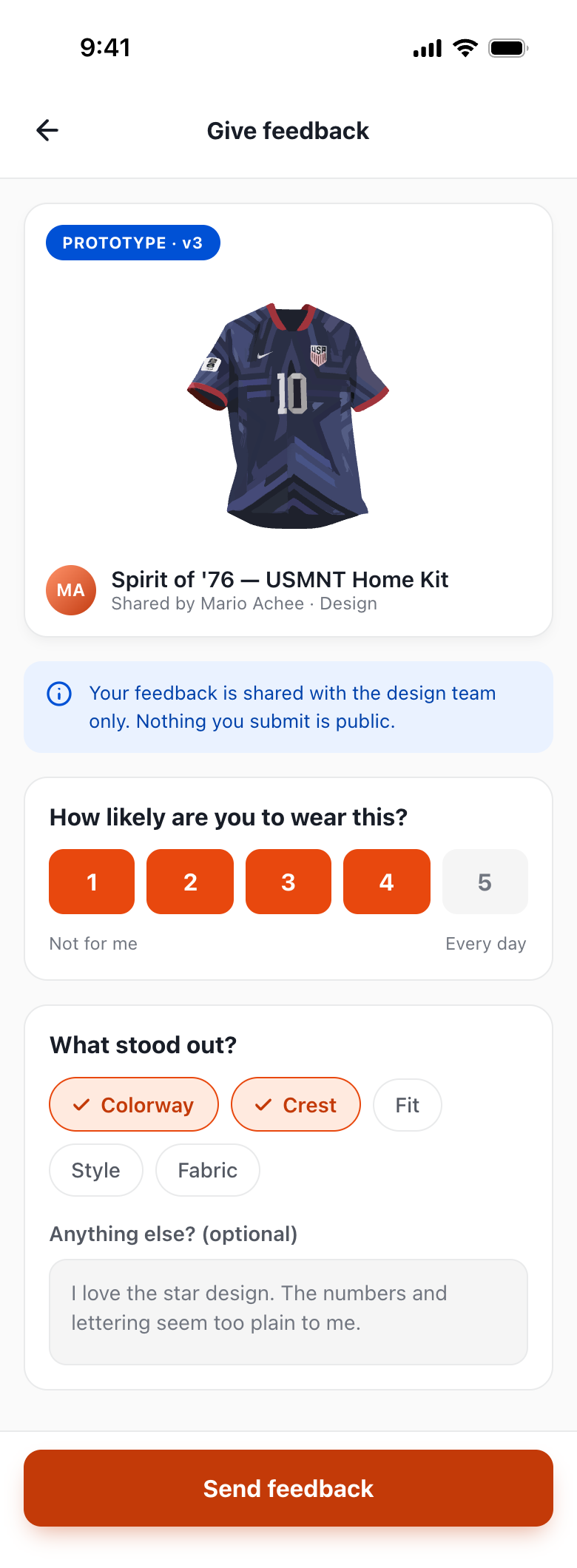
Prototype Feedback
One conversation to a working product. This is a real Conntinuum run.
The Specification Layer
## What a Conntinuum specification actually contains.
When we say "specification," we don't mean a requirements document someone writes and files away. A Conntinuum specification is a living, interconnected system of deliverables that together define your product completely.
### Product Strategy
Vision Board, Ideal Customer Profiles, User Personas, prioritized Feature List — produced by ProductXplorer and its specialist Splines.
### Feature Requirements
User stories with testable business rules, executable Gherkin acceptance criteria, and full BDD example mapping — produced by FRDXplorer and its Three Amigos pipeline.
### Architecture
Technical standards, system design, data models, API contracts, security requirements, infrastructure specifications — produced by ArchitectXplorer and six specialist Splines.
### Design
Screen specifications, interaction state machines, accessibility audits, design system tokens — produced by DesignXplorer and its specialist Splines.
### Quality
Comprehensive test plans covering functional, API, security, accessibility, and performance testing, plus automation strategy and regression planning — produced by TestXplorer and nine specialist Splines.
Every deliverable links to every other deliverable. Change a persona, and the features that serve that persona are flagged. Change a business rule, and the test cases that validate it update. Change an API contract, and the security threat model is re-evaluated. This is what makes Spec-Driven Development possible, and it's what makes Conntinuum fundamentally different from tools that skip straight to code.
The Architecture
## Specialized agents. Shared intelligence.
Conntinuum's Splines, our specialized AI agents, are organized into coordinated pipelines, each owning a phase of your product lifecycle. Every pipeline shares context with every other. 42+ Splines across 6 pipelines, and more coming online every week.
### Strategy & Discovery
6 Splines · Orchestrator: ProductXplorer
From a raw product idea to a complete strategic foundation, vision, audience, personas, features, and glossary, in a single working session.
### Requirements & Specification
6 Splines · Orchestrator: FRDXplorer
User stories, business rules, and executable acceptance criteria, traceable to every upstream decision and maintained as living documents.
### Design & Experience
6 Splines · Orchestrator: DesignXplorer
Design system, user flows, screen specs, interaction patterns, and WCAG accessibility audits, ready for Figma or direct implementation.
### Architecture & Engineering
9 Splines · Orchestrator: ArchitectXplorer
Technical standards, system design, data models, API contracts, security requirements, and infrastructure specs, validated for cross-deliverable consistency.
### Quality & Testing
10 Splines · Orchestrator: TestXplorer
Functional tests, API contracts, performance plans, security scenarios, accessibility verification, automation strategy, and regression suites, all traceable to requirements.
### Build & Deploy
5+ Splines · In active development
Code review, PR management, test execution, repository scaffolding, and cloud provisioning, extending the network from specification into implementation.
### Expanding Domains
Coming soon
New pipelines shipping continuously: legacy modernization, product marketing, mobile publishing, cloud optimization, monitoring, and pricing strategy. The Spline network keeps growing.
THE TEAM
## Splines work alongside every role on your team.
Every Spline is a specialist. Each one is trained on a specific discipline of software development and works within the context of your product — its strategy, its architecture, its decisions, and its constraints. They don’t replace your team. They make your team faster, more thorough, and more aligned.
### The Three Amigos — C3V Meets BDD
In BDD, the “Three Amigos” — Product, Architecture, and QA — collaborate to ensure every feature is fully understood before development begins. Conntinuum’s three orchestrator Splines embody this practice. Each one coordinates an entire pipeline of specialist Splines, and together they ensure that product strategy, technical design, and quality assurance are never siloed — they’re built into every deliverable from the start.
Product Amigo
#### ProductXplorer
Orchestrates your full strategic foundation — vision, ICPs, personas, features, and glossary. The Product perspective ensures every deliverable traces to user value and business intent.
Architecture Amigo
#### ArchitectXplorer
Orchestrates the complete architecture pipeline — technical standards, system design, data models, API contracts, security, and infrastructure. The Tech perspective ensures every decision is sound, documented, and validated.
QA Amigo
#### TestXplorer
Orchestrates the full testing pipeline — functional tests, API contracts, security, accessibility, performance, automation, and regression. The QA perspective ensures every specification is testable and every gap is surfaced.
Product Manager Your Product Manager is responsible for defining strategy, capturing stakeholder intent, and keeping every deliverable aligned with product vision. Working alongside her Splines, she doesn't just produce better documentation — she operates at a completely different scale. Strategic foundations, user research, feature prioritization, and stakeholder alignment that used to consume her entire quarter now happen continuously and collaboratively. She's not managing one product backlog. She's running three — and every one of them is more thorough than the single product she used to struggle to keep documented. SparkXplorer + 3 more · Show Splines Hide these Splines
#### SparkXplorer
Conversational Intake & Vision
Turns a raw product conversation into a structured Vision Board. The starting point for every product journey.
#### ProductXplorer
Strategic Foundation
Orchestrates your full strategic foundation: ICPs, personas, feature list, and glossary — from a single conversation.
#### FRDXplorer
Feature Requirements
Generates complete feature requirement documents with user stories, business rules, acceptance criteria, and executable Gherkin statements.
#### BacklogXplorer
Backlog Management
Maintains a centralized user story registry across all FRDs with planning metadata, status tracking, and GitHub sync.
Software Engineer Your Software Engineer is responsible for translating requirements into reliable, maintainable code. Working alongside his Splines, he stops being the person who asks "what does this ticket mean?" and becomes the person who ships. Full architecture context, data models, and API contracts are already in place when he picks up a feature — so he spends his time solving real engineering problems, not reverse-engineering intent from a two-sentence Jira ticket. The team that used to deliver six features a sprint is delivering twelve, and the code is cleaner than what they shipped when they were moving slower. ArchitectXplorer + 4 more · Show Splines Hide these Splines
#### ArchitectXplorer
System Architecture
Orchestrates the full architecture pipeline: TSD, system design, data models, API specs, security requirements, and infrastructure specs.
#### FTDXplorer
Feature Technical Design
Produces per-feature technical designs: API endpoints, data model changes, security considerations, and implementation guidance.
#### DataModelXplorer
Data Architecture
Designs entity relationships, database schemas, data dictionaries, and migration strategies aligned with your domain model.
#### APISpecXplorer
API Contracts
Generates OpenAPI-compatible endpoint definitions, request/response schemas, authentication patterns, and versioning strategies.
#### TSDXplorer
Technical Standards
Establishes product-wide technical standards: coding conventions, API patterns, security requirements, and compliance frameworks.
Designer Your Designer is responsible for crafting intuitive, accessible experiences that bring product requirements to life. Working alongside her Splines, she's no longer the person filling in gaps the product team left behind — she's designing from structured screen specs, interaction models, and accessibility audits that already account for every state and edge case. She used to spend half her week in clarification meetings. Now she spends it designing, and the work she produces covers twice the surface area with fewer revisions. DesignXplorer + 3 more · Show Splines Hide these Splines
#### DesignXplorer
Design Specification
Orchestrates the design pipeline: design system, user flows, screen specs, interaction patterns, and accessibility audits.
#### ScreenSpecXplorer
Screen Specifications
Produces implementation-ready screen specs: layout, component placement, states, validation rules, and responsive behavior.
#### InteractionSpecXplorer
Interaction Patterns
Defines state machines, transitions, micro-interactions, loading patterns, and form submission flows for every screen.
#### DesignSystemXplorer
Design System
Produces your component catalog, design tokens, pattern library, and responsive grid foundations.
QA Engineer Your QA Engineer is responsible for ensuring every feature meets its acceptance criteria before it reaches a customer. Working alongside his Splines, he's no longer the last line of defense scrambling to catch what everyone else missed — he's operating from comprehensive test plans that were generated alongside the specifications, not after them. Test coverage isn't a guess anymore. It's a measured, traceable fact. He used to be the person who slowed releases down. Now he's the reason they ship with confidence. TestXplorer + 4 more · Show Splines Hide these Splines
#### TestXplorer
Test Orchestration
Orchestrates the full testing pipeline: strategy, functional tests, API tests, security, accessibility, performance, automation, and regression.
#### TestCaseXplorer
Functional Test Cases
Generates detailed test cases from FRD rules and Gherkin statements with full traceability and coverage gap analysis.
#### SecurityTestXplorer
Security Testing
Produces OWASP Top 10 scenarios, auth/authz tests, input validation tests, and compliance checklists.
#### AccessibilityTestXplorer
Accessibility Testing
Generates WCAG 2.1/2.2 test cases, screen reader scenarios, keyboard navigation tests, and assistive tech compatibility matrices.
#### PerformanceTestXplorer
Performance Testing
Defines load profiles, stress scenarios, SLA thresholds, soak tests, and capacity planning recommendations.
Security & Infrastructure Your Security and Infrastructure leads are responsible for ensuring the product is secure, compliant, and operationally ready from day one. Working alongside their Splines, security and infrastructure aren't afterthoughts bolted on before launch — they're designed into the architecture from the first specification. Threat models, compliance mappings, deployment architecture, and scaling strategies are produced and validated against each other automatically. The audit that used to require a month of scrambling now takes a conversation. SecuritySpecXplorer + 2 more · Show Splines Hide these Splines
#### SecuritySpecXplorer
Security Requirements
Generates threat models, security controls, auth architecture, encryption requirements, and compliance framework mappings.
#### InfraSpecXplorer
Infrastructure & DevOps
Specifies deployment architecture, CI/CD pipelines, monitoring, disaster recovery, and scaling strategies.
#### SystemDesignXplorer
System Architecture
Designs service boundaries, technology stack selection, architectural patterns, and scalability approach.
Project Manager / Leadership Your Project Manager is responsible for keeping the entire product lifecycle visible, coordinated, and on track. Working alongside his Splines, he's no longer the person chasing people for status updates — the system tells him where everything stands. Roadmaps update when specs change. Release readiness is a dashboard, not a gut feeling. He used to spend 80% of his time gathering information and 20% acting on it. Now those numbers are reversed, and he's managing a portfolio instead of drowning in a single project. UserJourneyXplorer + 2 more · Show Splines Hide these Splines
#### UserJourneyXplorer
User Journeys & Flows
Produces experience-level user journeys and critical product flows that inform every downstream specification.
#### GovernanceXplorer
Project Governance
Bootstraps and maintains assumption registries, decision logs, open questions, and documentation structure.
#### RegressionXplorer
Regression & Release Readiness
Defines regression suites, smoke tests, change impact analysis, and release readiness checklists with measurable gates.
40+ deployed Splines and growing.
A NEW WAY TO BUILD
## What changes for your team.
Conntinuum doesn’t just add AI to your existing process. It transforms how every person on your team does their job — from how product managers capture intent to how engineers access specifications to how QA engineers trace coverage. Here’s what that looks like, role by role.
| Role | Today | With Conntinuum | Impact |
| --- | --- | --- | --- |
| Product Manager | Spends 3–5 days writing PRDs from scratch in Google Docs. Copies them into Confluence, where they’re immediately outdated and never read again. Stakeholder alignment requires three rounds of meetings, two follow-up Slack threads, and a passive-aggressive email chain before everyone agrees on something that changes again next sprint. | Has a conversation with SparkXplorer. A structured Vision Board, ICPs, user personas, and a prioritized feature list emerge from that conversation. Updates propagate automatically across every connected deliverable. No Confluence page required. | 3x more products managed per PM 80% reduction in specification time Zero documentation drift |
| Software Engineer | Opens a Jira ticket with two sentences of context and an acceptance criteria that says “user can log in.” Spends 30% of sprint time asking clarifying questions in Slack, but gets ignored by everyone except the product manager trainee who just came back from a week of vacation, missed all the meetings, and provides out-of-date answers. Discovers mid-build that the spec was updated last Tuesday and nobody told the team. | Opens the feature in Conntinuum and sees the full FRD: user stories, business rules, acceptance criteria, Gherkin statements, architecture decisions, and data model — all traceable to the original product intent. Fires up the CodeXplorer Splines and puts them to work building the feature. | 2x feature throughput per sprint 60% reduction in clarification cycles Zero context-switching to find specs |
| Designer | Gets a brief that says “make it intuitive.” Guesses at interaction states and edge cases. Delivers wireframes in Figma, then discovers in QA that three error states were never accounted for. Accessibility is an afterthought bolted on two days before launch. Back to Figma. 🤷 | DesignXplorer generates screen specs, interaction state machines, and WCAG accessibility audits directly from the FRD. Every screen traces back to a user story. Every state is accounted for. Figma gets fed specifications instead of guesses. | 70% fewer revision cycles 100% accessibility coverage from day one 2x design surface area per designer |
| QA Engineer | Gets pulled into feature planning the day before the sprint ends. Writes test cases from specs so vague they could describe three different features. Discovers edge cases during testing that should have been caught in requirements. Ships anyway because the release date doesn’t move. Nobody checks if the tests are passing. Nobody checks if there are tests. | TestXplorer produces comprehensive test cases, API contract tests, security scenarios, and accessibility audits — all traceable to specific FRD rules and Gherkin statements. Tests execute automatically after every commit and the plan is updated immediately by TestPlanXplorer. Coverage gaps are surfaced before a single line of code is written. | 90% test traceability to requirements Minutes to build a test plan, not days Zero “did anyone check the tests?” moments |
| Engineering Leader / CTO | Architecture decisions live in someone’s head — and that someone left six months ago. Technical debt accumulates because the team moves too fast to document anything. New hires take weeks to understand why anything was built the way it was. The answer is usually “nobody knows.” Proceeds to lose all remaining hair. | ArchitectXplorer produces the TSD, system design, data model, API contracts, security requirements, and infrastructure spec — all validated against each other. Every decision has a rationale. Every standard is documented. New hires are fully productive in hours, not weeks. | 100% architecture decision documentation Hours to a productive new hire, not weeks Zero undocumented tribal knowledge |
| Project Manager | Maintains a spreadsheet of user stories manually, because he used Microsoft Project at his last job but this company uses Asana — and it doesn’t matter anyway because nobody else on the team even has a license. Status updates require chasing five people across Slack, Jira, and email. Release readiness is a gut feeling, not a measurable gate. | PjMXplorer generates phased roadmaps and sprint plans from the feature list. The user story registry auto-updates when FRDs change. Release readiness checklists have measurable, objective criteria. One tool. One source of truth. | 80% less time gathering status Real-time release readiness Portfolio management, not project drowning |
Product Manager Tap to compare “Today” vs Conntinuum Hide comparison
Today
Spends 3–5 days writing PRDs from scratch in Google Docs. Copies them into Confluence, where they’re immediately outdated and never read again. Stakeholder alignment requires three rounds of meetings, two follow-up Slack threads, and a passive-aggressive email chain before everyone agrees on something that changes again next sprint.
With Conntinuum
Has a conversation with SparkXplorer. A structured Vision Board, ICPs, user personas, and a prioritized feature list emerge from that conversation. Updates propagate automatically across every connected deliverable. No Confluence page required.
Impact
3x
more products managed per PM
80%
reduction in specification time
Zero
documentation drift
Software Engineer Tap to compare “Today” vs Conntinuum Hide comparison
Today
Opens a Jira ticket with two sentences of context and an acceptance criteria that says “user can log in.” Spends 30% of sprint time asking clarifying questions in Slack, but gets ignored by everyone except the product manager trainee who just came back from a week of vacation, missed all the meetings, and provides out-of-date answers. Discovers mid-build that the spec was updated last Tuesday and nobody told the team.
With Conntinuum
Opens the feature in Conntinuum and sees the full FRD: user stories, business rules, acceptance criteria, Gherkin statements, architecture decisions, and data model — all traceable to the original product intent. Fires up the CodeXplorer Splines and puts them to work building the feature.
Impact
2x
feature throughput per sprint
60%
reduction in clarification cycles
Zero
context-switching to find specs
Designer Tap to compare “Today” vs Conntinuum Hide comparison
Today
Gets a brief that says “make it intuitive.” Guesses at interaction states and edge cases. Delivers wireframes in Figma, then discovers in QA that three error states were never accounted for. Accessibility is an afterthought bolted on two days before launch. Back to Figma. 🤷
With Conntinuum
DesignXplorer generates screen specs, interaction state machines, and WCAG accessibility audits directly from the FRD. Every screen traces back to a user story. Every state is accounted for. Figma gets fed specifications instead of guesses.
Impact
70%
fewer revision cycles
100%
accessibility coverage from day one
2x
design surface area per designer
QA Engineer Tap to compare “Today” vs Conntinuum Hide comparison
Today
Gets pulled into feature planning the day before the sprint ends. Writes test cases from specs so vague they could describe three different features. Discovers edge cases during testing that should have been caught in requirements. Ships anyway because the release date doesn’t move. Nobody checks if the tests are passing. Nobody checks if there are tests.
With Conntinuum
TestXplorer produces comprehensive test cases, API contract tests, security scenarios, and accessibility audits — all traceable to specific FRD rules and Gherkin statements. Tests execute automatically after every commit and the plan is updated immediately by TestPlanXplorer. Coverage gaps are surfaced before a single line of code is written.
Impact
90%
test traceability to requirements
Minutes
to build a test plan, not days
Zero
“did anyone check the tests?” moments
Engineering Leader / CTO Tap to compare “Today” vs Conntinuum Hide comparison
Today
Architecture decisions live in someone’s head — and that someone left six months ago. Technical debt accumulates because the team moves too fast to document anything. New hires take weeks to understand why anything was built the way it was. The answer is usually “nobody knows.” Proceeds to lose all remaining hair.
With Conntinuum
ArchitectXplorer produces the TSD, system design, data model, API contracts, security requirements, and infrastructure spec — all validated against each other. Every decision has a rationale. Every standard is documented. New hires are fully productive in hours, not weeks.
Impact
100%
architecture decision documentation
Hours
to a productive new hire, not weeks
Zero
undocumented tribal knowledge
Project Manager Tap to compare “Today” vs Conntinuum Hide comparison
Today
Maintains a spreadsheet of user stories manually, because he used Microsoft Project at his last job but this company uses Asana — and it doesn’t matter anyway because nobody else on the team even has a license. Status updates require chasing five people across Slack, Jira, and email. Release readiness is a gut feeling, not a measurable gate.
With Conntinuum
PjMXplorer generates phased roadmaps and sprint plans from the feature list. The user story registry auto-updates when FRDs change. Release readiness checklists have measurable, objective criteria. One tool. One source of truth.
Impact
80%
less time gathering status
Real-time
release readiness
Portfolio
management, not project drowning
Works where you work
## Deep Integrations.
Conntinuum works with the tools your team already uses — enhancing workflows instead of replacing them.
Conversations

Slack

Zoom

Teams

Meet

Gmail

Outlook
In Person
Project Tools

Notion

Linear

Jira

Confluence
UI & UX Design

Figma

Paper
Development

GitHub

Cursor

GitLab
What's In A Name?
## Conntinuum means something.
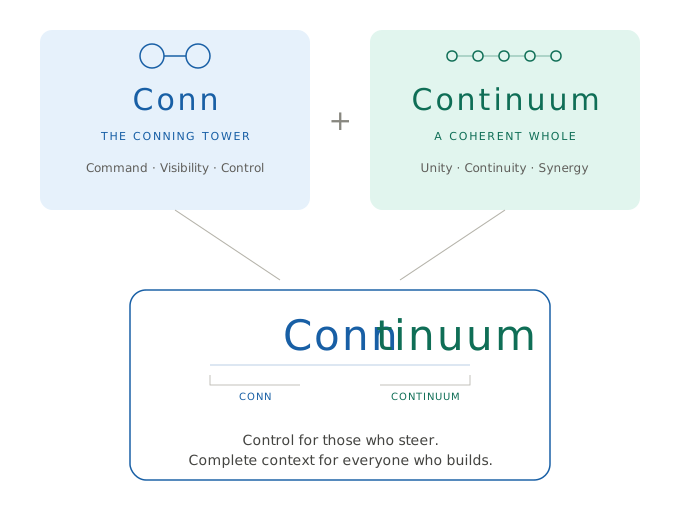
"Conn" comes from the conning tower, the raised platform from which an officer controls a vessel and maintains visibility of everything in motion. In product development, that kind of control rarely exists. Decisions get made in rooms, on calls, in threads, and by the time they reach the people building the product, the intent behind them is already distorted.
A continuum is a collection of distinct parts operating as a coherent whole, each element doing what it does best, the sum greater than its parts.
Conntinuum is both. It gives every leader, every team, and every stakeholder the visibility and control they need, while ensuring the whole organization moves as one.
The Methodology
## Built on a framework, not just a feeling.
Every Spline output and deliverable associated with your product is built on the C3V framework, Conntinuum's methodology for product development that ensures every deliverable meets a consistent standard of quality, clarity, and value. C3V isn't a checklist. It's the philosophy embedded in everything the platform produces, and the same methodology C Infinity delivers with every day. [Read the full C3V methodology](https://www.cinfinitysolutions.com/c3v-methodology?hsLang=en).
### Clarity
Every output is written so every stakeholder, human or machine, technical or non-technical, can understand it, act on it, and trace it back to the decision that created it.
### Collaboration
Built-in review workflows ensure that Product, Engineering, and Quality perspectives are represented in every deliverable, not just the loudest voice in the room.
### Craftsmanship
Quality gates ensure that every specification, requirement, and architectural decision meets the standard your engineers need to build from confidently.
### Value
Every feature, every decision, and every line of output must articulate measurable user or business value. If it doesn't serve the product and customer, it doesn't ship.
Keep exploring: read about [the problem Conntinuum solves](https://www.cinfinitysolutions.com/conntinuum/the-problem?hsLang=en), or see the platform work on your own idea in [Spark Lab](https://www.cinfinitysolutions.com/conntinuum/spark-lab?hsLang=en).
Spark Lab
## Start your product journey with a conversation.
Spark Lab is where your product journey with Conntinuum begins. Tell one of our AI product managers what you're building, a new product, an internal tool, a business automation, or a legacy modernization, and they'll ask the right questions, surface blind spots, and deliver a structured Vision Board in a single session. It's not a demo. It's the first real step toward shipping your product. Results in about 10 minutes.
If we are, we will tell you what the work looks like. If we are not, we will tell you that too, and point you toward someone who is. Sometimes the right answer is "not yet."
[Try Spark Lab →](https://www.cinfinitysolutions.com/conntinuum/spark-lab?hsLang=en) [Get in touch →](https://www.cinfinitysolutions.com/contact?hsLang=en)
Technology and AI solutions, delivered smoothly. Engineered with Conntinuum.
[](https://www.cinfinitysolutions.com/?hsLang=en)
Technology and AI solutions, delivered smoothly.
Custom software, AI, and technology solutions, expertly crafted for the Agentic era, orchestrated by senior Product Engineers. Commercial and public sector.
[Open Spark Lab](https://sparklab.conntinuum.com) [Get in touch](https://www.cinfinitysolutions.com/contact?hsLang=en)
Limitless monthly
#### Get our new insights delivered right to your inbox.
We think a lot about products, AI, software development, business strategy, and a whole bunch more. We try to write as much as we can and hope that it's valuable for you.
This site is protected by reCAPTCHA and the Google [Privacy Policy](https://policies.google.com/privacy) and [Terms of Service](https://policies.google.com/terms) apply.
[mailto:info@cinfinitysolutions.com](mailto:info@cinfinitysolutions.com)
#### What We Do
[The Work We Deliver](https://www.cinfinitysolutions.com/what-we-do?hsLang=en) [Build](https://www.cinfinitysolutions.com/build?hsLang=en) [Modernize](https://www.cinfinitysolutions.com/modernize?hsLang=en) [Automate](https://www.cinfinitysolutions.com/automate?hsLang=en) [Implement](https://www.cinfinitysolutions.com/implement?hsLang=en) [Operate](https://www.cinfinitysolutions.com/operate?hsLang=en) [Strategize](https://www.cinfinitysolutions.com/strategize?hsLang=en)
#### Platform & Method
[Conntinuum](https://www.cinfinitysolutions.com/conntinuum) [The Problem](https://www.cinfinitysolutions.com/conntinuum/the-problem?hsLang=en) [Spark Lab](https://www.cinfinitysolutions.com/conntinuum/spark-lab?hsLang=en) [C³V Methodology](https://www.cinfinitysolutions.com/c3v-methodology?hsLang=en)
#### Company
[Our Company](https://www.cinfinitysolutions.com/our-company?hsLang=en) [What is C Infinity](https://www.cinfinitysolutions.com/what-is-c-infinity?hsLang=en) [Our People](https://www.cinfinitysolutions.com/our-people?hsLang=en) [Guiding Principles](https://www.cinfinitysolutions.com/guiding-principles?hsLang=en) [Engagement Models](https://www.cinfinitysolutions.com/engagement-models?hsLang=en) [Careers](https://www.cinfinitysolutions.com/careers?hsLang=en)
#### Resources
[Insights](https://www.cinfinitysolutions.com/insights?hsLang=en) [Limitless](https://www.cinfinitysolutions.com/insights/limitless?hsLang=en) [Glossary](https://www.cinfinitysolutions.com/glossary?hsLang=en) [Partnerships & Certifications](https://www.cinfinitysolutions.com/partnerships-and-certifications?hsLang=en) [Government](https://www.cinfinitysolutions.com/government?hsLang=en)
#### Get started
[Contact](https://www.cinfinitysolutions.com/contact?hsLang=en) [Open Spark Lab](https://sparklab.conntinuum.com) [Forge](https://www.cinfinitysolutions.com/forge?hsLang=en)
SDVOSB State of California DVBE Certified Small Business Administration Certified NVBDC Certified NVSBC Member
Engineered with Conntinuum.
[info@cinfinitysolutions.com](mailto:info@cinfinitysolutions.com) [Privacy](https://www.cinfinitysolutions.com/privacy?hsLang=en) [Terms](https://www.cinfinitysolutions.com/terms?hsLang=en) Service-Disabled Veteran-Owned Small Business (SDVOSB) · © 2026 C Infinity Solutions LLC
```json
{
"@context" : "https://schema.org",
"@type" : "Organization",
"description" : "C Infinity is the digital product and technology firm building custom software and AI for Fortune 500 enterprises, growing companies, and government agencies.",
"email" : "info@cinfinitysolutions.com",
"legalName" : "C Infinity Solutions",
"logo" : "//243464465.fs1.hubspotusercontent-na2.net/hubfs/243464465/raw_assets/public/c-infinity/images/horizontal-white.png",
"name" : "C Infinity",
"sameAs" : [ "https://www.linkedin.com/company/c-infinity-solutions/", "https://x.com/CInfinityCo" ],
"url" : "https://www.cinfinitysolutions.com"
}
```